How Motorcycle Brakes and ABS Work, Explained in 3D
Your lever, the brake fluid and four caliper pistons, then how cornering ABS reads your lean. Built in 3D from Honda's Africa Twin manuals.
In this article
Most riders know two things about their brakes: squeeze the lever and the bike slows down, and ABS stops the wheel from locking. Most also believe a third thing that Honda's own owner's manual says is wrong: that ABS makes you stop shorter.
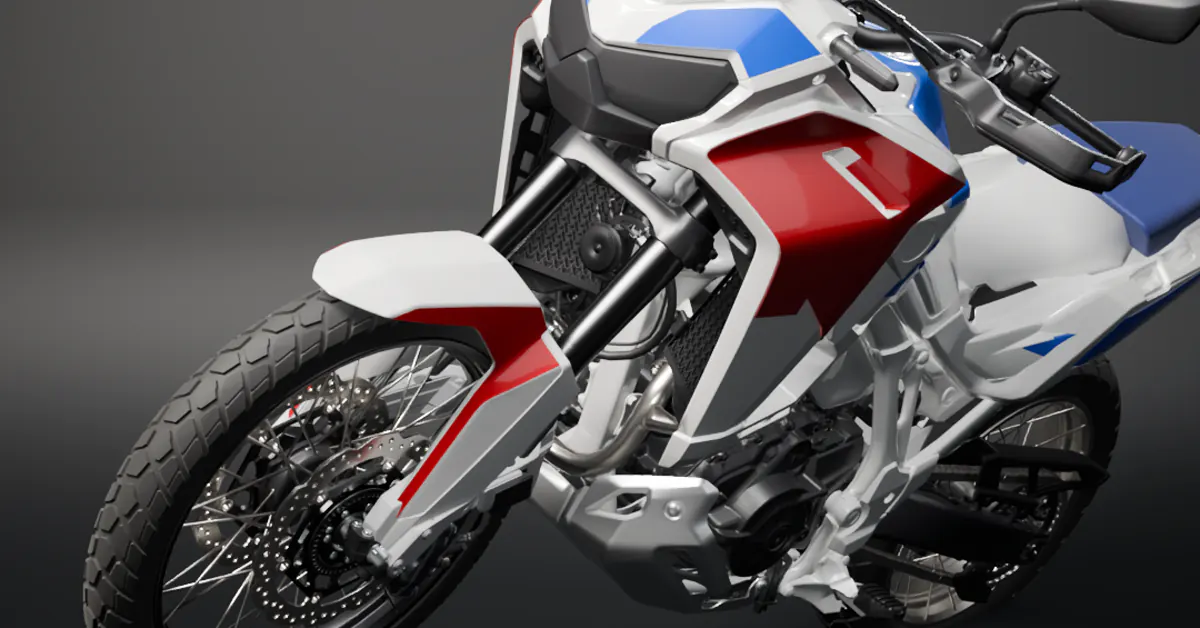
This guide shows how motorcycle brakes and ABS work, one step at a time, using 3D cutaways of a real bike: a 2022 Honda Africa Twin (CRF1100). Every number comes from Honda's shop manual or owner's manual, and the page is listed under each one. By the end you should be able to explain to a riding friend, in one breath, how two fingers on a lever stop a loaded adventure bike and what the ABS actually does when you grab it too hard.
Before you scroll, make a guess: your fingers push a piston 14 mm across. How much harder do you think each brake pad gets pushed? Hold that number. We'll check it in a minute.
Part 1: How your front brake works
Step 1: your lever pushes a small piston
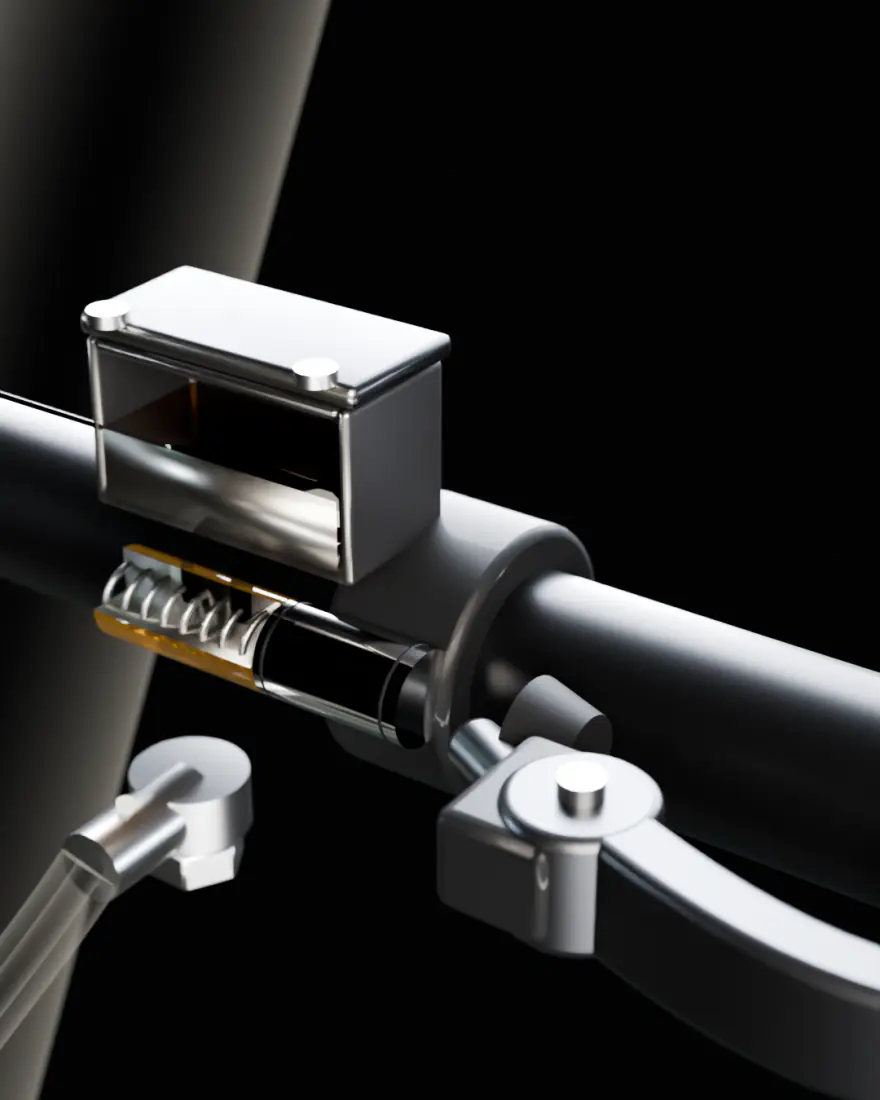
The brake lever doesn't touch the brakes at all. It pushes a small piston inside the master cylinder, the box on the right handlebar with the fluid reservoir on top. On the Africa Twin that piston is 14 mm across (shop manual, p. 1-14). A spring behind it pushes it back when you let go.
When the piston moves, it shoves brake fluid out of the cylinder and down the hose.
Step 2: the fluid carries the push, like a full syringe
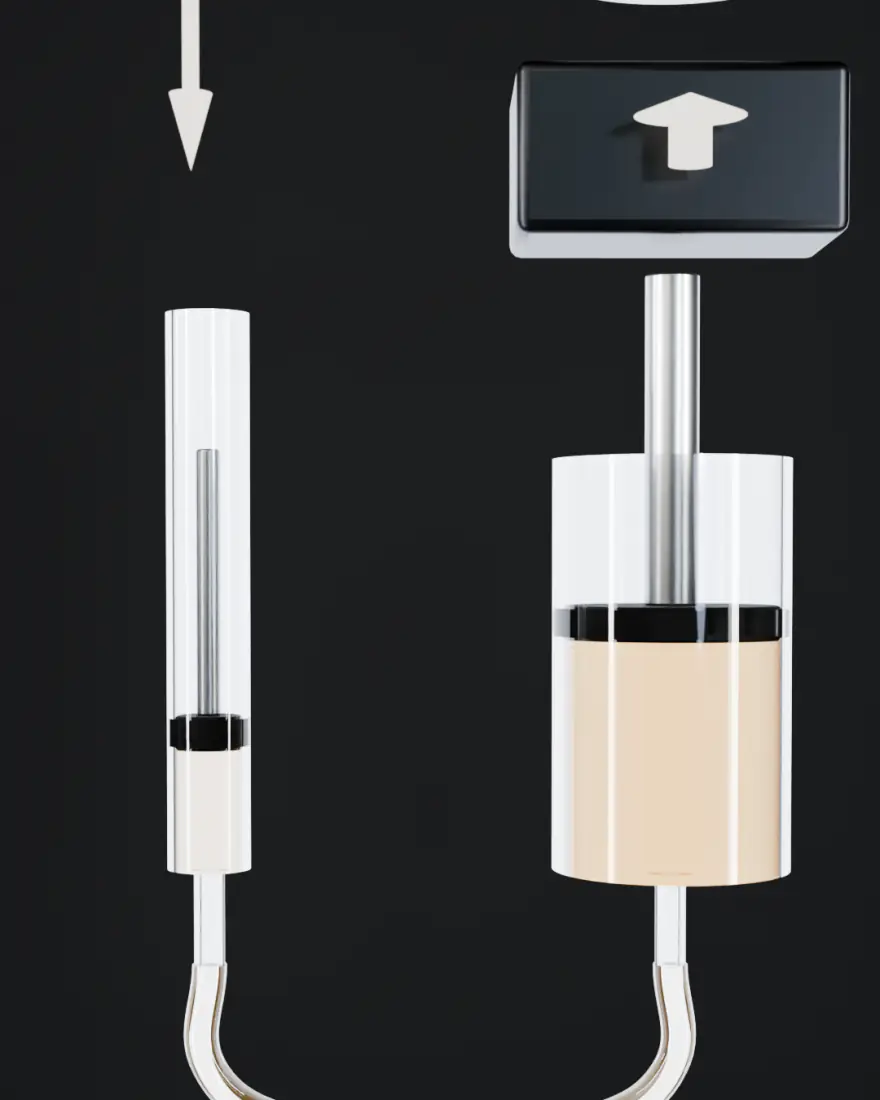
Here's the one idea the whole system rests on: brake fluid can't be squeezed smaller. Push on one end of a hose full of it and the other end pushes back right away, with the same pressure everywhere in the line.
Think of two syringes joined by a tube, both full of liquid. Push the thin plunger and the fat one rises. The thin one has to travel a long way, the fat one moves only a little, but it pushes much harder. Same pressure, bigger area, more force. That trade (long, light push in; short, strong push out) is the trick your front brake uses.
The fluid in your Africa Twin is DOT 4 (owner's manual, p. 262).
Step 3: four bigger pistons squeeze the pads
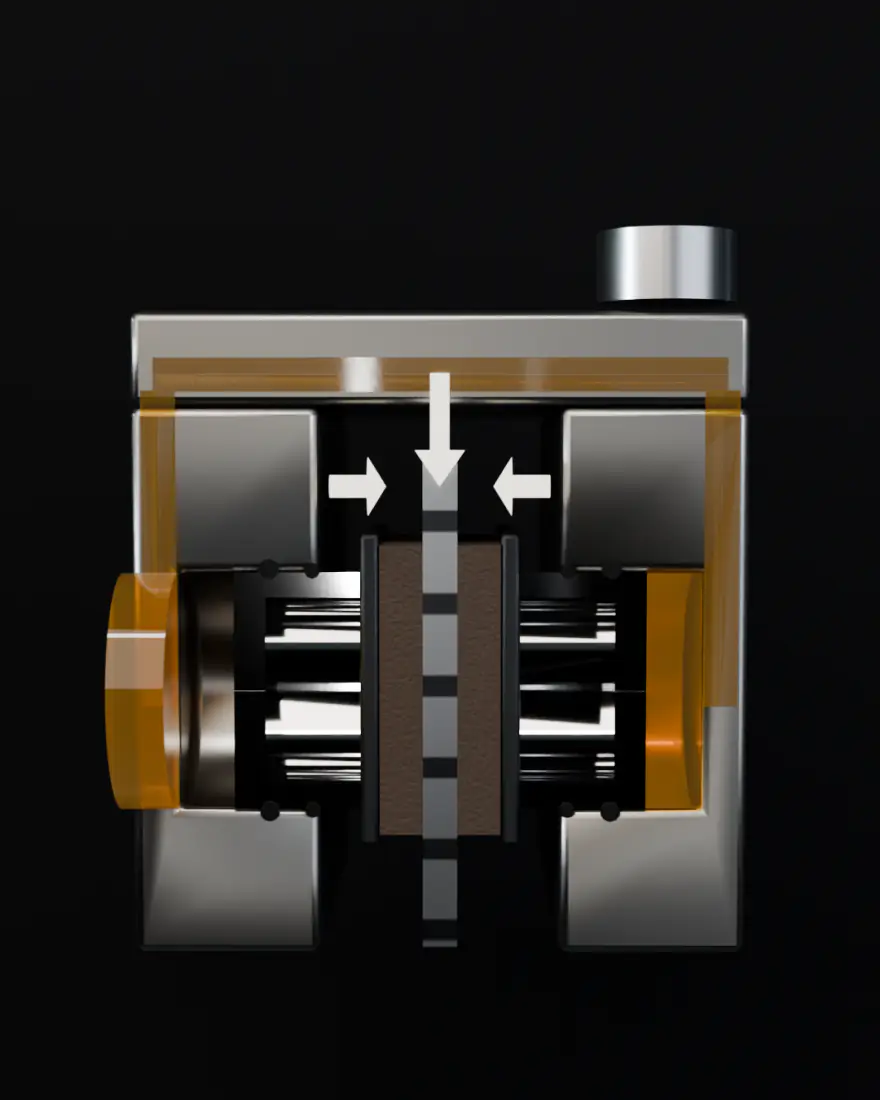
The hose ends at the caliper, the part that hugs the brake disc. Each front caliper on the Africa Twin has four pistons, two on each side of the disc: a 30 mm one and a 27 mm one per side (shop manual, p. 1-14 and p. 19-20). The fluid pressure that left your 14 mm piston now pushes on all of them at once.
Now check your guess. Area grows with the square of the diameter, so:
| Diameter | Area | |
|---|---|---|
| Master piston (your lever) | 14.0 mm | 154 mm² |
| Pistons behind one pad (30 + 27 mm) | 30.2 + 26.9 mm | 1,285 mm² |
| Ratio | ≈ 8.35× |
So each pad is pushed about 8 times harder than the piston at your lever. (That's the force on the master piston, not your finger: the lever's own leverage multiplies it further, but Honda doesn't publish that number, so we won't guess it.) If you guessed "about the same", you're in good company. It's the most common answer, and the syringe trick is why it's wrong.
Step 4: the pads turn your speed into heat
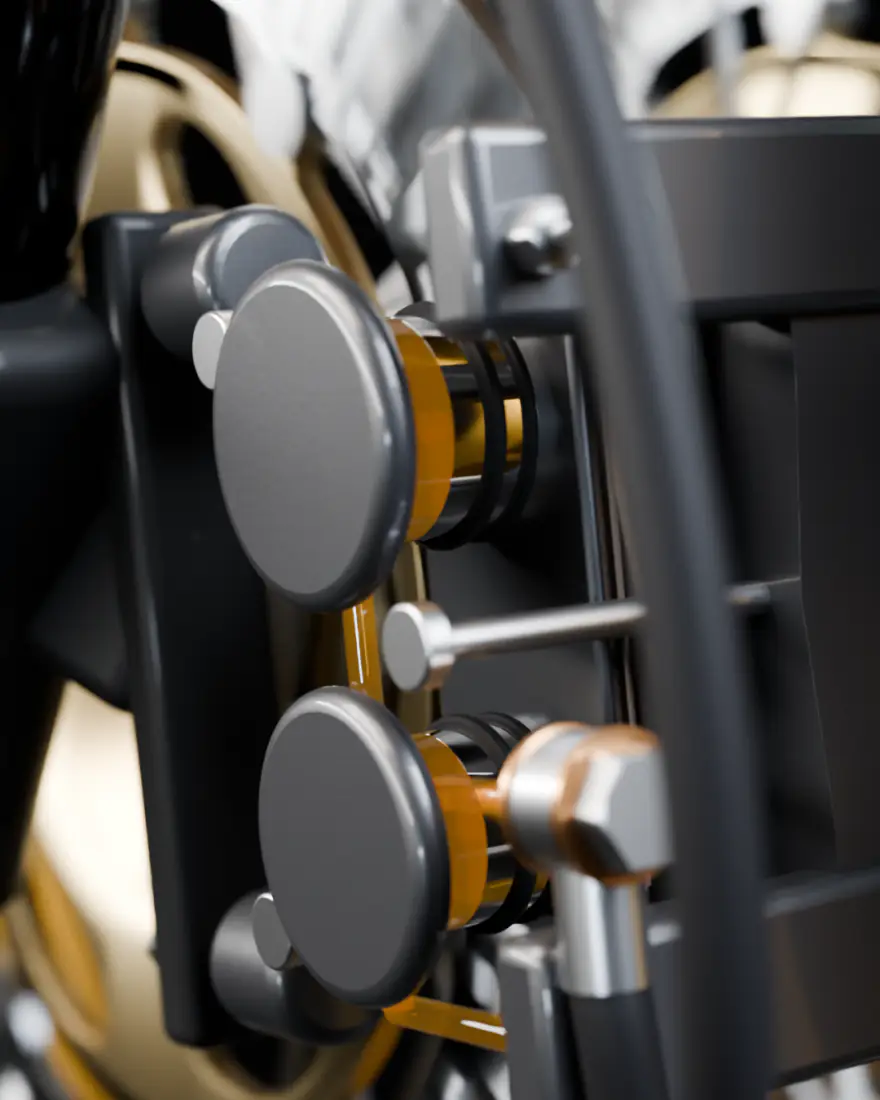
The pistons press the brake pads onto the spinning disc. Friction between pad and disc turns the bike's movement into heat. That's all braking is: speed in, heat out. The Africa Twin does this twice at the front, with two 310 mm floating discs and a radial-mount four-piston caliper on each (Honda specifications).
The whole chain in one line
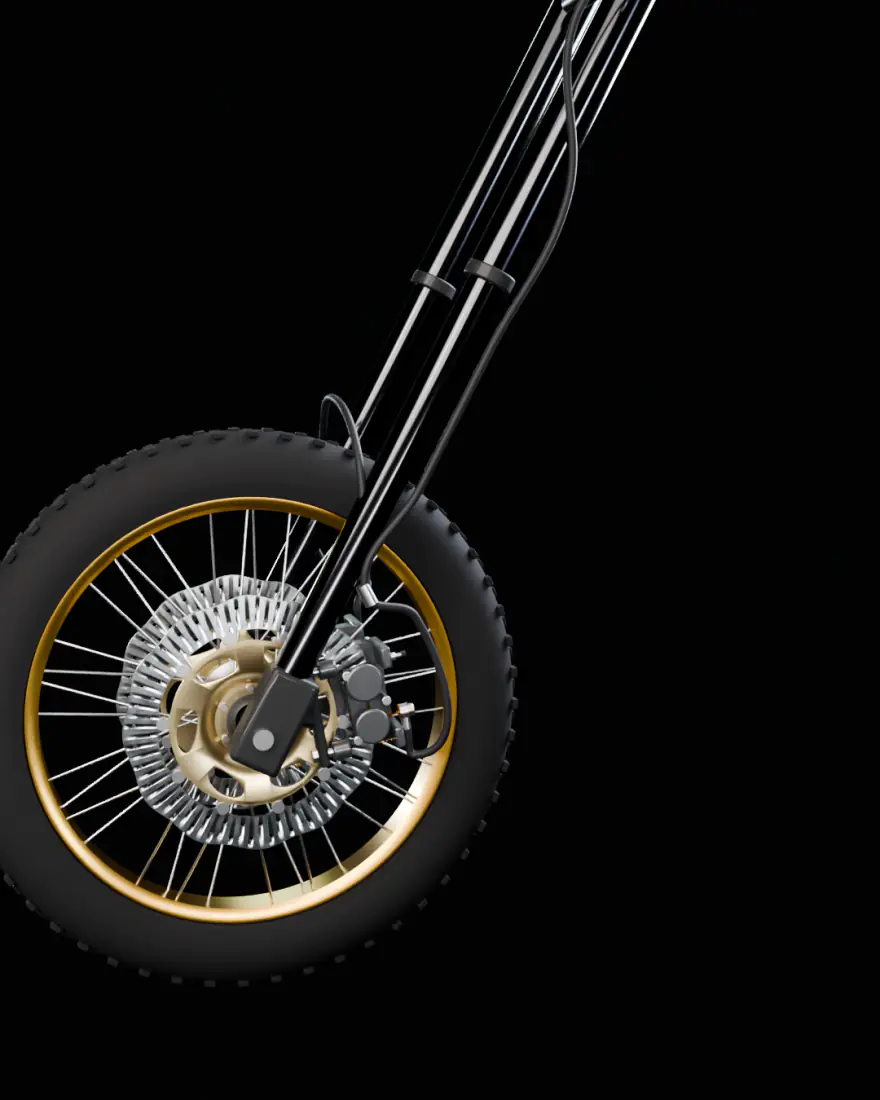
Lever → small piston → fluid → four bigger pistons → pads → disc. If you remember one sentence from this page, make it that one.
Part 2: How ABS works
Now picture braking too hard, on a wet road or a patch of gravel. The pads grip the disc so hard that the wheel stops turning while the bike is still moving. A locked front wheel slides, and a sliding front wheel can't steer. ABS (anti-lock braking system) exists to catch that moment. Honda describes it as a system "designed to help prevent the brakes from locking up during hard braking" (owner's manual, p. 15).
To do that, it needs to answer one question many times a second: is this wheel about to lock? Before reading on, think about it: what would you need to measure to know that?
Three parts do the job
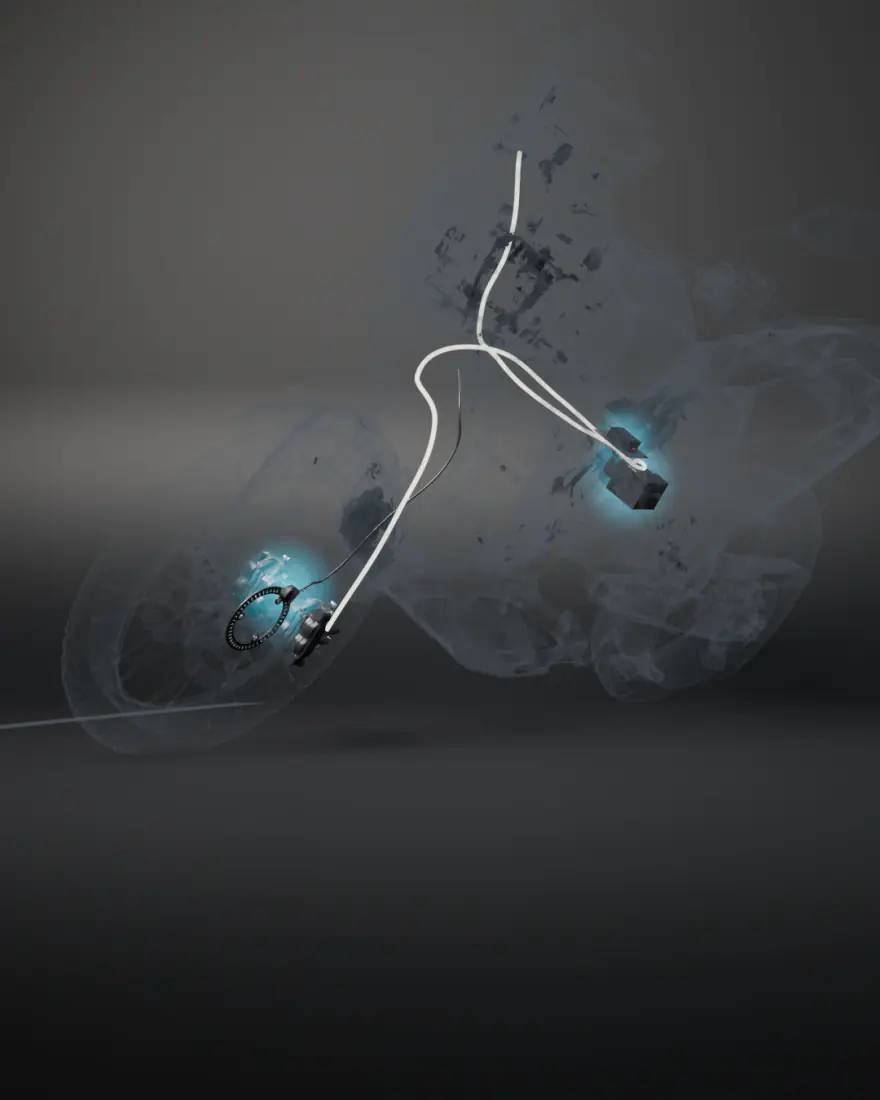
On the Africa Twin there are three:
- A wheel speed sensor at each wheel.
- The ABS unit (Honda calls it the ABS modulator), which sits in the brake line between your lever and the caliper.
- An IMU (inertial measurement unit), a motion sensor mounted on the ABS unit (shop manual, p. 4-73).
The wheel speed sensor counts slots
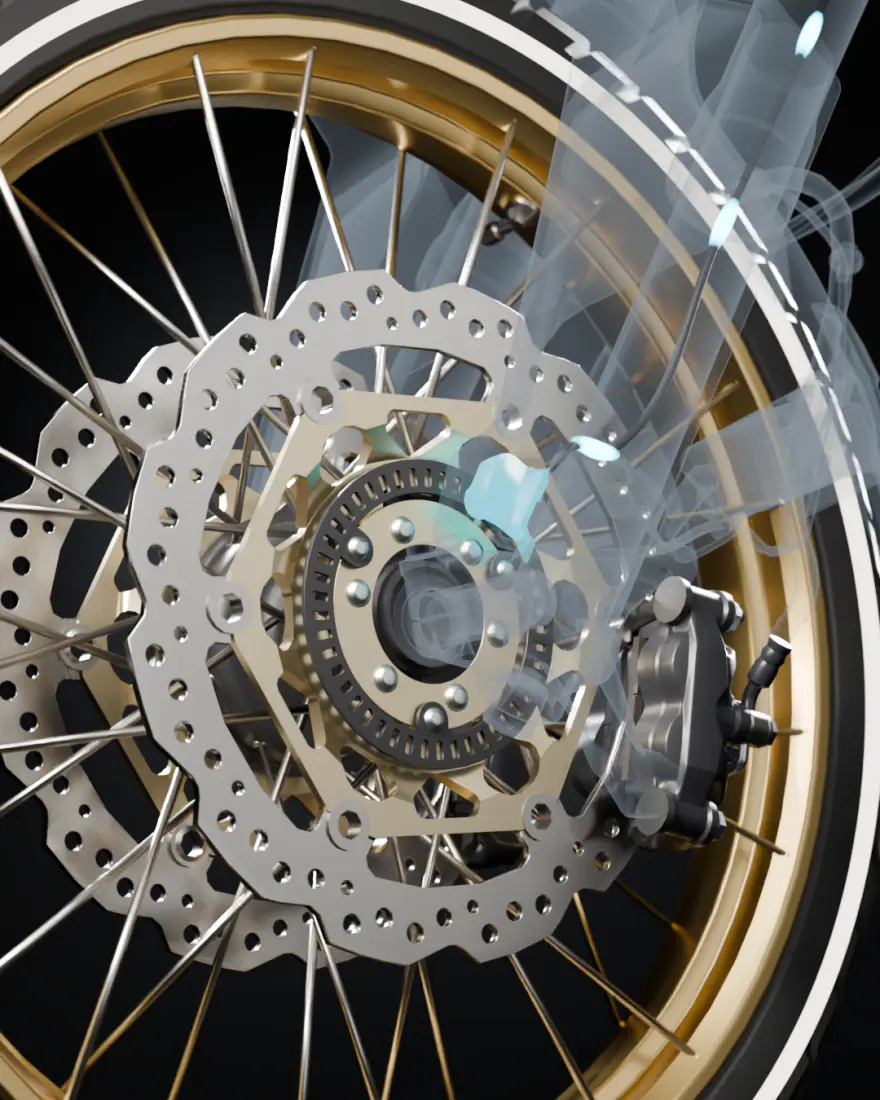
Next to each brake disc is a ring with slots in it. As the wheel turns, the slots pass the sensor and it sends a pulse for each one to the ABS unit (shop manual, p. 20-6). Faster wheel, faster pulses. Slower wheel, slower pulses.
"About to lock" means the wheel slows faster than the bike
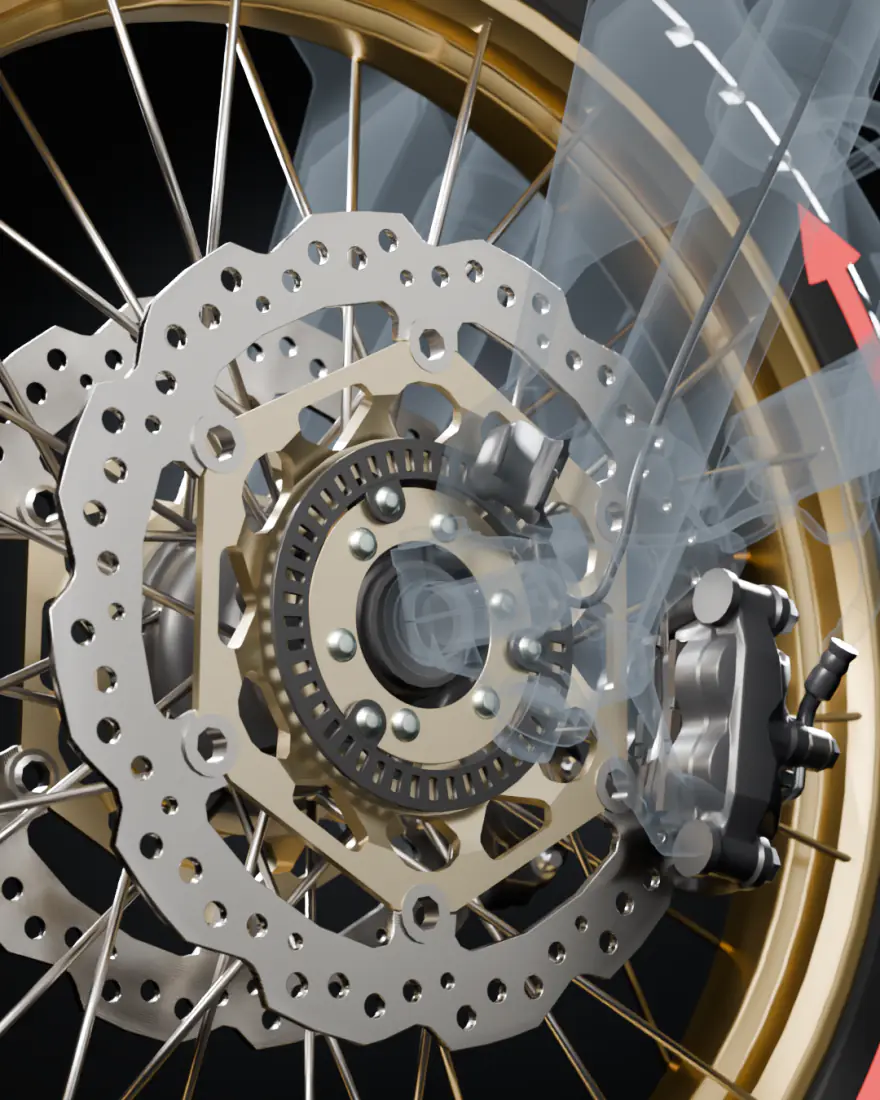
Here's the answer to the question above. When you brake normally, the wheel and the bike slow down together. When you brake too hard, the wheel slows down faster than the bike. The pulses from that wheel suddenly spread apart while the bike is still carrying its speed. That gap between wheel speed and bike speed (the shop manual calls it the slip ratio, p. 1-83) is the warning sign.
The ABS unit eases the pressure for a split second
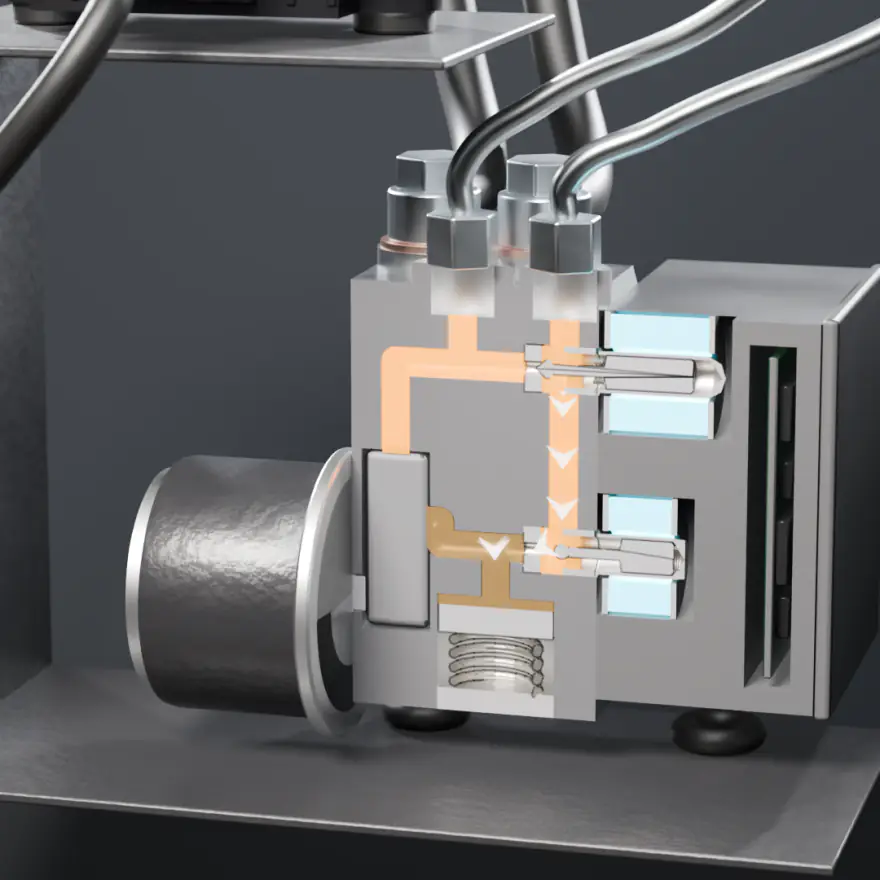
When the ABS unit sees a wheel about to lock, it works "by reducing the brake pressure" to that wheel (shop manual, p. 1-83). Valves inside it let a little pressure off the caliper side, the wheel starts turning again, and then the pressure comes back. It repeats as long as the wheel keeps trying to lock.
The easiest way to picture it: it's you easing off the lever for a split second, done for you, faster than you could do it. (The picture above is a schematic. Nobody publishes the inside of this unit, so the layout is drawn to explain the idea, not copied from the real part.)
You can sometimes feel this. Honda's owner's manual says: "The brake lever and pedal may recoil slightly when applying the brakes. This is normal" (p. 15). If your lever kicks back under hard braking, the ABS is doing its job.
Part 3: How cornering ABS knows you're leaned over
Braking in a straight line is the easy case. Mid-corner, leaned over, the tyre is already using part of its grip to hold the turn. So ABS needs to know one more thing: how far you're leaning. That's what the third part is for.
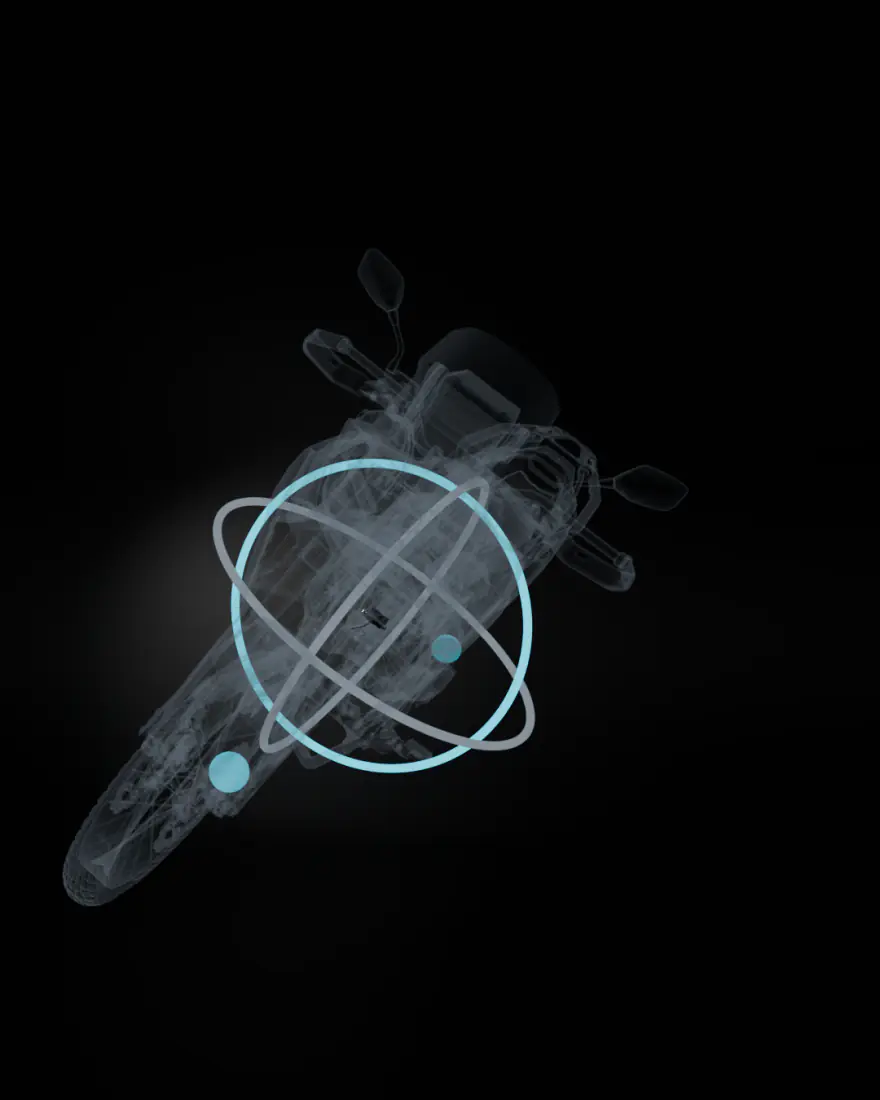
The IMU on the Africa Twin is a six-axis sensor. It measures acceleration forwards, sideways and up-and-down, plus how fast the bike rotates in roll, pitch and yaw (shop manual, p. 1-82). From that, together with the two wheel speed sensors, the system estimates the bank angle (shop manual, p. 1-83). It then varies the point where ABS steps in depending on that lean, so that "even when sudden braking is applied during cornering, the braking force can be generated while maintaining high stability" (shop manual, p. 1-83).
Note the careful wording. Honda says the threshold changes with lean. It doesn't say whether ABS steps in earlier or later, so we won't claim either.
The three-part summary: sense the wheel, sense the lean, ease the pressure.
The myth: "ABS makes you stop shorter"
This is the one most riders get wrong, and Honda is blunt about it: "ABS does not reduce braking distance. In certain circumstances, ABS may result in a longer stopping distance" (owner's manual, p. 15).
That fits what you've just learned. ABS works by taking pressure away when a wheel is about to lock. Its job is to keep the wheel turning so you can still steer and stay upright, not to brake harder than you can. Leave the same following distance you would without it.
Two more facts from the same page that are worth knowing:
- ABS switches off below 10 km/h (6 mph) (owner's manual, p. 15). At walking pace you're braking without it.
- The ABS light comes on when you turn the key and goes out at about 10 km/h. If it stays on, "your brakes will continue to work as a conventional system, but without the anti-locking function" (owner's manual, p. 114 and p. 313). Get it checked.
On the Africa Twin, only the rear ABS can be switched off, only in the OFF ROAD ABS mode, and it comes back on every time you turn the ignition on (owner's manual, p. 124).
Check yourself
Try answering these out loud before you read the answers.
- Why does each pad get pushed harder than the piston at your lever?
- How does the ABS unit know a wheel is about to lock?
- Why does cornering ABS need the IMU?
Answers. (1) The fluid can't be squeezed, so the same pressure reaches bigger pistons at the caliper, and bigger area means more force: about 8× on the Africa Twin. (2) The wheel's pulses slow down faster than the bike does. (3) Leaned over, the tyre has less grip to spare for braking, so the system needs the lean angle, worked out from the IMU and the wheel speeds, to decide when to step in.
If you got all three, you understand your brakes better than most riders on the road.
Keeping it working
Everything above depends on parts that wear. Honda's maintenance schedule for the Africa Twin includes:
| What | Rule | Source |
|---|---|---|
| Brake fluid (DOT 4) | Replace every 2 years | Shop manual p. 3-2, owner's manual p. 253 |
| Brake pads | Check for wear; replace in pairs | Owner's manual p. 283 |
| Brake discs | Service limit 3.5 mm thick | Shop manual p. 1-14 |
Brake fluid absorbs water over time, which is why the change is by time, not mileage. It's the brake job that's easiest to forget. For the full schedule, see the Honda Africa Twin CRF1100 maintenance schedule. For the jobs themselves: changing motorcycle brake fluid, replacing brake pads yourself, and why brakes squeak.
MotoVault reminds you when the brake fluid is due by date and by distance, and keeps every brake job in your bike's service log. It's free on iOS and Android.
The 3D images were built from Honda's shop manual drawings and dimensions. Small movements (pad gap, piston travel) are exaggerated so they can be seen, and the inside of the ABS unit is a schematic. Always follow the service manual for your exact model and year.
Sources
- Honda CRF1100L Africa Twin Owner's Manual (2022): p. 15 (ABS function, braking distance, 10 km/h, lever recoil), p. 114 and 313 (ABS indicator), p. 124 (rear ABS cancel in OFF ROAD mode), p. 253 (brake fluid interval), p. 262 (DOT 4), p. 283 (brake pads)
- Honda CRF1100L Africa Twin Shop Manual: p. 1-14 (master cylinder bore, caliper piston sizes, disc thickness and service limit, brake fluid), p. 1-82 and 1-83 (IMU, bank-angle estimation, cornering ABS), p. 3-2 (maintenance schedule), p. 4-73 (IMU mounting), p. 19-20 (caliper construction), p. 20-6 (wheel speed sensor signals)
- Honda Africa Twin specifications (powersports.honda.com, 2025/2026 model year): dual 310 mm floating discs, radial-mount four-piston calipers
This article is for general information only. Always confirm details against official manufacturer documentation and your owner's manual before acting on them.
Questions riders ask
How does motorcycle ABS work?
A speed sensor at each wheel counts slots on a ring as the wheel turns. When a wheel slows down faster than the bike, it is about to lock, and the ABS unit briefly lowers the brake pressure to that wheel so it keeps turning, then restores it. Source: Honda CRF1100L shop manual, p. 1-83 and 20-6.
Does ABS make a motorcycle stop shorter?
No. Honda's owner's manual says ABS does not reduce braking distance and in certain circumstances may result in a longer stopping distance. Its job is to keep the wheel from locking so you can still steer. Source: Honda CRF1100L owner's manual, p. 15.
Why does my brake lever kick back when ABS works?
The ABS unit is releasing and restoring pressure in the brake line. Honda says the brake lever and pedal may recoil slightly when the brakes are applied, and that this is normal. Source: Honda CRF1100L owner's manual, p. 15.
What is cornering ABS?
ABS that also uses an IMU (a six-axis motion sensor) together with the wheel speed sensors to estimate how far the bike is leaned, and varies the point where ABS steps in so the bike stays stable when you brake in a corner. Source: Honda CRF1100L shop manual, p. 1-82 and 1-83.
How often should motorcycle brake fluid be changed?
Honda's maintenance schedule for the Africa Twin says to replace the DOT 4 brake fluid every 2 years, regardless of mileage, because brake fluid absorbs moisture over time. Source: Honda CRF1100L shop manual, p. 3-2; owner's manual, p. 253.
Related articles
- Honda CB750 Hornet Service Intervals & Oil ChangeThe full Honda CB750 Hornet maintenance schedule: oil, valves, chain and fluids, in metric and imperial, from the official owner's manual.8 min read
- Kawasaki KLR650 Service Intervals & Oil ChangeThe full Kawasaki KLR650 service schedule for the 2022+ fuel-injected model: oil, valve, chain and coolant intervals in miles and kilometres.7 min read
- Kawasaki Versys 650 Service Intervals & Oil ScheduleThe full Kawasaki Versys 650 (KLE650) factory service schedule — oil, valves, coolant and brake fluid — with metric and imperial figures.7 min read